


 Skip to content
 Services › Solver
by Metacomp Technologies
General-purpose CFD for incompressible and compressible flows, on any mesh type.
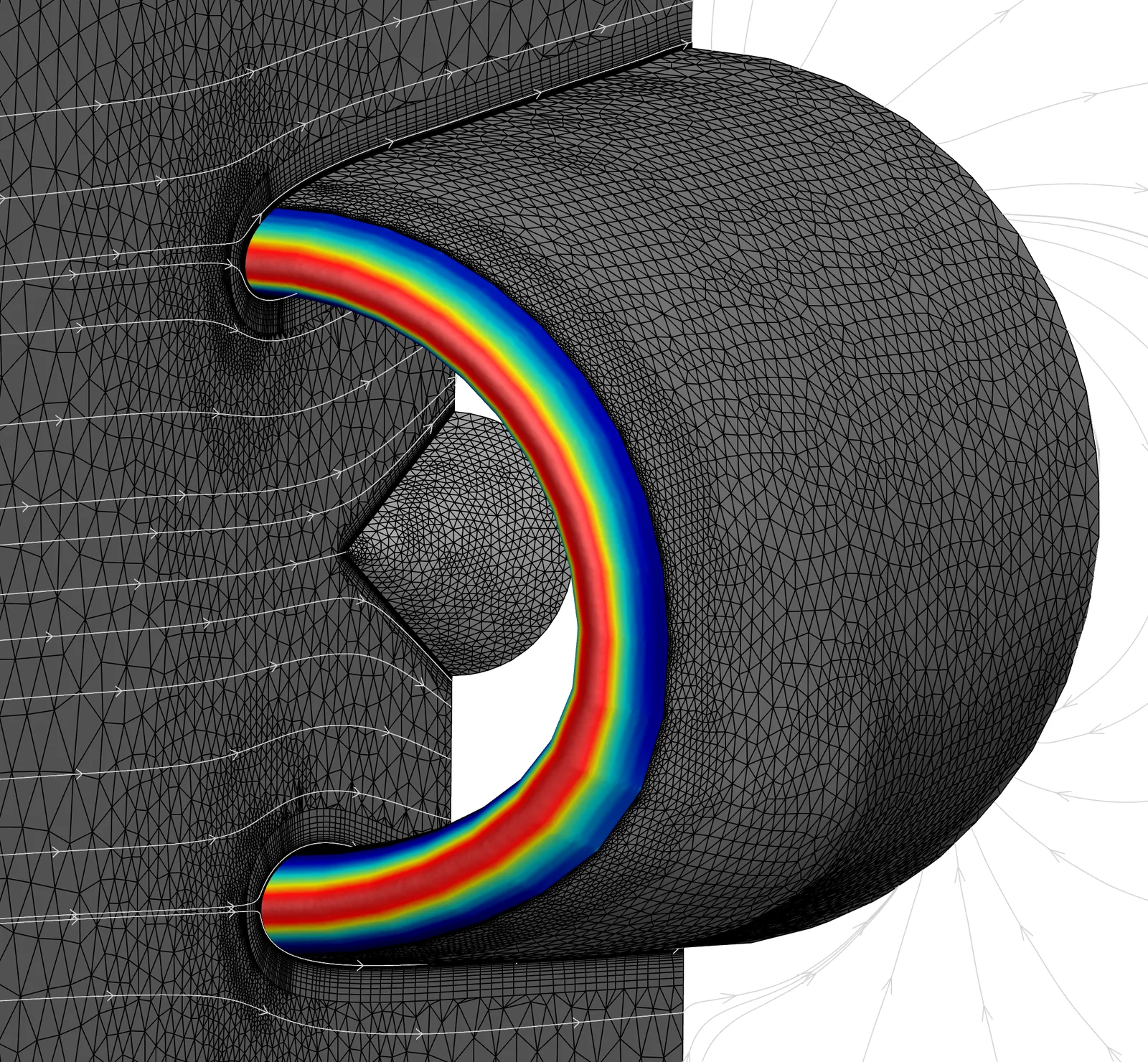
Incompressible to supersonic flows in the same solver, including problems where low- and high-speed regions coexist in the same domain, with preconditioning in the low-Mach regions.
Multidimensional reconstruction keeps the formal order of accuracy on arbitrary meshes. By default all transport variables are second-order in space, and the HLLC Riemann solver enforces positivity and an entropy condition.
CFD++ turbulence models are local, with no dependence on wall distance, which suits unstructured meshes and parallel computing, and they include built-in realizability constraints.
Runs on Linux and Windows x86-64 and on AWS, scaling from one to thousands of cores. Parallel jobs are set up like serial ones, and files are compatible across platforms.
CFD++ is Metacomp Technologies' computational fluid dynamics solver for steady and unsteady, internal and external, compressible and incompressible, single- and multiphase flows. A single code handles structured, unstructured, multi-block and overset meshes, a broad family of turbulence models, and combustion, radiation and conjugate heat transfer physics.
Hexahedral, tetrahedral, prism, pyramid and polyhedral cells in the same mesh, plus multi-block, patched, non-aligned, sliding and overset grids, with conservation handled across interfaces.
One- to seven-equation RANS models (SA, SST, realizable k-ε, RSTM), Langtry-Menter transition, LES and hybrid RANS/LES (DES, DDES, IDDES, LNS), with wall functions for any y+.
Coupled density- or pressure-based solver, low-speed preconditioning and multidimensional TVD interpolation with approximate Riemann solvers to capture shocks in supersonic flow.
Arrhenius chemistry, flamelets and EDC; Eulerian and Lagrangian dispersed phases, VOF, cavitation, evaporation and condensation; thermal and chemical non-equilibrium for reentry flows.
Rotating frames, sliding and overset meshes, a 6DOF module with rigid-body dynamics, and radial basis function (RBF) mesh morphing.
Adjoint solver for sensitivities and shape optimization; conjugate heat transfer, P1 and DO radiation, and fluid-thermal-structure coupling with CSM++ through MetaFSI.
Select an image to see each example.
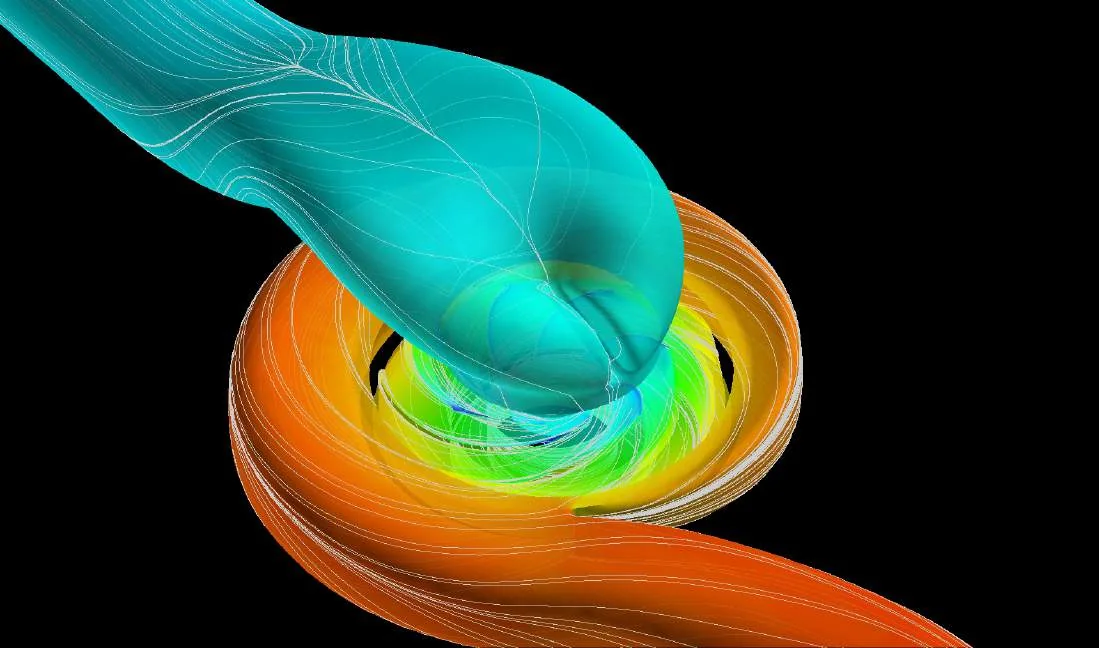
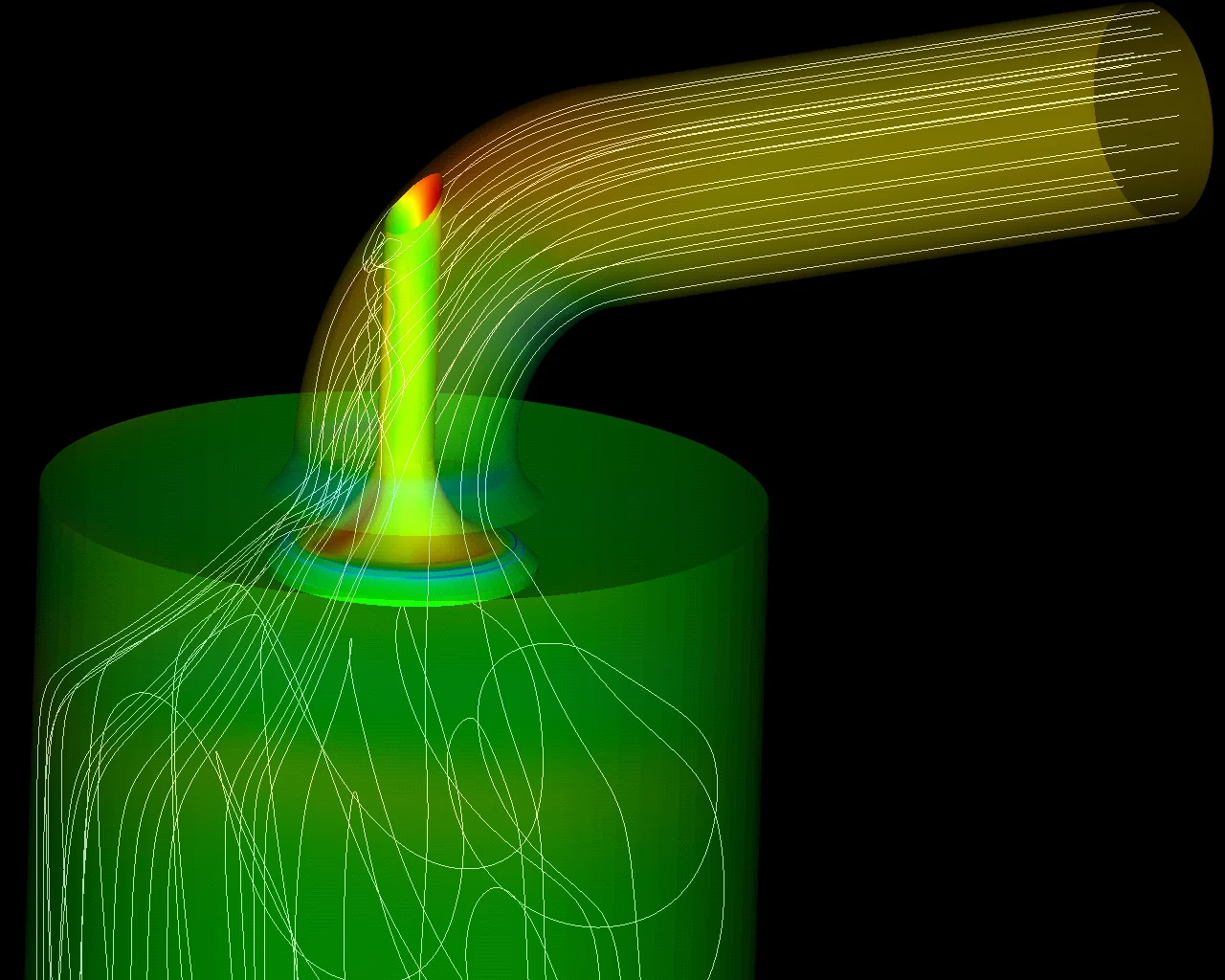
Head loss, efficiency and cavitation in process and water pumps.
Colored streamlines through the volute and impeller of a water pump.
Evaluation licenseScalability is one of the strengths of CFD++: simulation time drops as more cores are added. The actual gain depends on the hardware and on the case being simulated.
CFD++ is developed by a team that helped create the numerical methods and turbulence models used in CFD today.
One of the pioneers of CFD. He worked with Stanley Osher at UCLA and later at Rockwell on upwind methods. The Chakravarthy–Osher TVD schemes carry his name, and he co-authored one of the papers that founded ENO schemes. He founded Metacomp in 1994.
Metacomp's technical reference and the person responsible for developing CFD++ and all of the company's products. He is the lead author of the 1997 paper that introduced the CFD++ “grid-transparent” methodology, which lets the same solver run on structured, unstructured and hybrid meshes.
A reference in engineering turbulence modeling. Author of the backflow model for separated flows, the Rt model, the wall-distance-free k-ε model and the R-γ transition model, developed at Metacomp.
Co-author of the reference paper on wave speeds for the HLLC Riemann solver and of the LNS and synthetic turbulence methods that couple RANS and LES. He co-authors the reports of the AIAA High-Lift Prediction Workshop hybrid RANS/LES group.
According to Sukumar Chakravarthy, founder of Metacomp
Citation counts from Crossref, September 2026. Databases such as Google Scholar show higher numbers.
Try CFD++ on your own case before buying, with an ATS engineer alongside.
Courses taught by engineers who use CFD++ on real aerospace, mining, oil and gas and industry projects.
Local technical support and help setting up and validating your first project.
Yes. ATS provides an evaluation license on request and supports the trial with local technical support, ideally on a case representative of your work, so the comparison with your current tool is made under real conditions.
ATS presents the CFD++ licensing options and builds the proposal around your use: number of users, application types and available computing resources.
CFD++ runs on Linux and Windows x86-64 and on AWS, over Gigabit and 10 Gigabit Ethernet, InfiniBand and proprietary interconnects such as Cray and SGI MPT. The executable can be launched from the GUI or from the command line.
Yes. ATS offers training in Portuguese by engineers who use CFD++ on projects, plus first-project assistance. Metacomp's standard course is a two-day overview of the suite and assumes no prior CFD++ experience.
Tell us about your case. An ATS engineer will get in touch to show CFD++ running on a problem similar to yours.