Skip to content


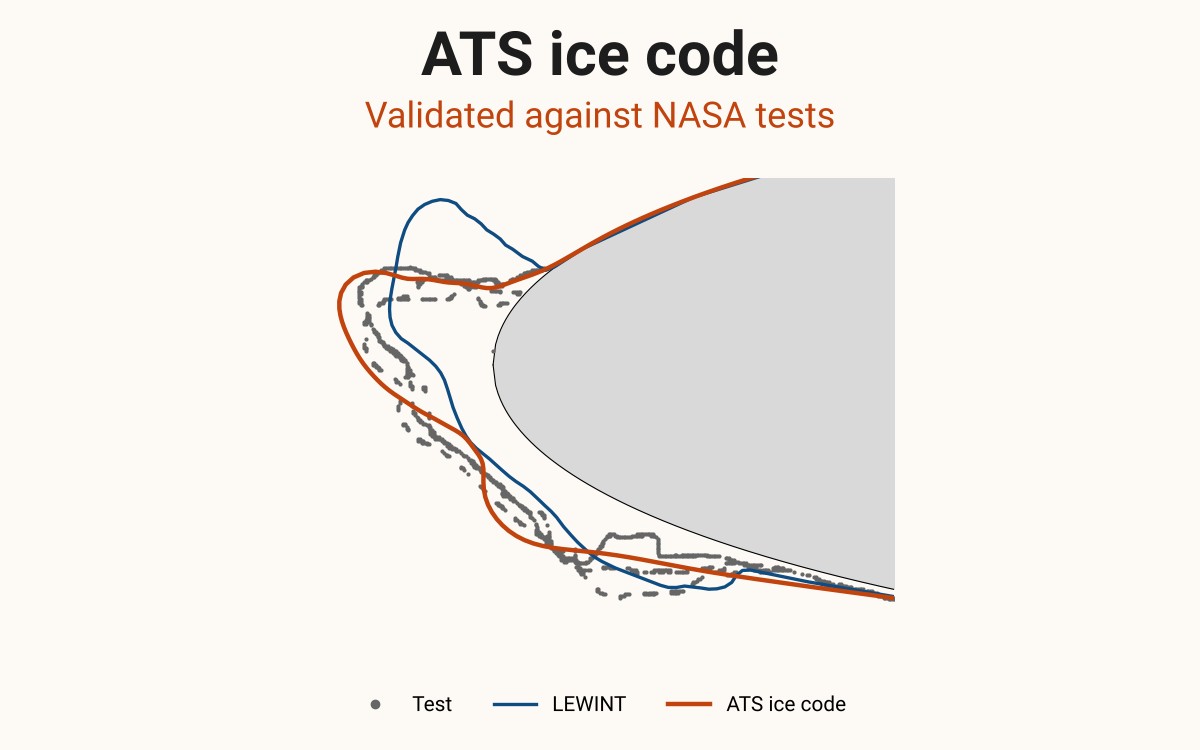
The ATS ice code is ATS’s 2D ice accretion model. It computes the ice shape on an airfoil from the flight and cloud condition, like NASA’s LEWICE. This post shows the ice accretion model against the Shin and Bond test in the NASA Icing Research Tunnel, case by case, with LEWINT alongside.
Cover image: ice shape of case 6c (−5.6 °C): test, ATS ice code and LEWINT.
- Ten cases of the Shin and Bond test (NASA TM‑105743, 1992): NACA 0012, five temperatures and two speeds, glaze and rime ice.
- Mean shape error: 0.25 % of chord for the ATS ice code and 0.31 % for LEWINT 1.04 at the same conditions.
- The ATS ice code has a lower error in 5 cases, the same in 3 and a higher one in 2.
- The results are from the project version, the one ATS uses on its work. The applet on the ice accretion page and the code sent through the site are an earlier, simpler version.
What a 2D model is for
In ice protection system and certification projects, the design ice shape comes from CFD++ in 3D, from LEWINT and from icing tunnel tests. The ATS ice code comes before and alongside them. It runs dozens of FAR 25 Appendix C envelope conditions quickly, shows which condition is critical and cross‑checks the other tools. A model that disagrees with the test is no use for that check, so validation comes first.
The Shin and Bond test
Shin and Bond measured ice shapes on a NACA 0012 airfoil with a 0.533 m (21 in) chord in the NASA Icing Research Tunnel, at 4° angle of attack and 20 µm MVD. There are two series: series 6 at 130 KTAS with an LWC of 1.0 g/m³ for 6 min, and series 7 at 200 KTAS with 0.55 g/m³ for 7 min. Each series sweeps total temperature from −2.2 °C to −26.1 °C, from horned glaze near 0 °C to cold rime. It is a public test, widely used to validate icing codes, including LEWICE itself.
The measured shapes were digitized from the report figures. The ATS ice code and LEWINT 1.04 ran at the same conditions, with the tunnel pressure at 2000 ft.

Results case by case
The mean shape error is the mean distance between the measured points and the computed contour, in the iced region, as a percentage of chord.
| Case | Tt (°C) | KTAS | LWC (g/m³) | min | Ice | ATS ice code | LEWINT 1.04 |
|---|---|---|---|---|---|---|---|
| 6a | −2.2 | 130 | 1.0 | 6 | glaze | 0.30 | 0.40 |
| 6b | −3.9 | 130 | 1.0 | 6 | glaze | 0.23 | 0.29 |
| 6c | −5.6 | 130 | 1.0 | 6 | glaze | 0.21 | 0.41 |
| 6d | −11.1 | 130 | 1.0 | 6 | glaze | 0.29 | 0.29 |
| 6e | −26.1 | 130 | 1.0 | 6 | rime | 0.14 | 0.14 |
| 7a | −2.2 | 200 | 0.55 | 7 | glaze | 0.42 | 0.38 |
| 7b | −3.9 | 200 | 0.55 | 7 | glaze | 0.31 | 0.42 |
| 7c | −5.6 | 200 | 0.55 | 7 | glaze | 0.17 | 0.30 |
| 7d | −11.1 | 200 | 0.55 | 7 | glaze | 0.22 | 0.21 |
| 7e | −26.1 | 200 | 0.55 | 7 | rime | 0.20 | 0.20 |
| Mean | 0.25 | 0.31 | |||||
In rime (6e and 7e) both codes are the same and close to the test. The largest differences between the two show in glaze between −4 °C and −6 °C (6b, 6c, 7b, 7c), where horn size is hardest to predict. Near 0 °C (7a) and at −11 °C in the fast series (7d), LEWINT is slightly better. The error grows near 0 °C in both codes, as in every classical icing code.
The model equations
The ATS ice code follows the classical Messinger method, the same as the reference 2D codes. The flow around the airfoil comes from a Hess and Smith panel method with the Prandtl‑Glauert compressibility correction. Droplets are integrated from upstream with the Langmuir and Blodgett equation:
dup/dt = (1/K)·(1 + 0.197 Re0.63 + 2.6×10⁻⁴ Re1.38)·(ua − up), K = ρw d² V / (18 μ c)
The collection efficiency comes from each droplet’s impact position, and gives the water reaching each panel of length Δs:
β = |dy0/ds|, ṁim = β · LWC · V · Δs
Mass conservation and the first law hold on each panel. Water that does not freeze runs back to the next panel:
ṁim + ṁrb,in = ṁev + ṁice + ṁrb,out
ṁim(cwTs + V²/2) + ṁrb,incwTrb = h(Tw − Trec)Δs + qcondΔs + ṁevLv + ṁrb,outcwTw + ṁice(ciTw − Lf)
The terms are the same as in the LEWICE 3.2 manual: convection minus kinetic heating, conduction into the ice, evaporation, droplet kinetic energy, latent heat and sensible heat. Evaporation uses the Chilton‑Colburn analogy, and conduction into the ice is transient, in a semi‑infinite medium:
qcond = (2√(kiρici)/√π) · (√t2 − √t1)/(t2 − t1) · (Tw − Tt)
With Tw = 0 °C the freezing mass follows; if it exceeds the available water, the regime is rime and Tw < 0 is solved from the balance. The freezing fraction is Nf = ṁice/(ṁim + ṁrb,in). Ice density comes from the Jones (1990) correlation, and the contour grows along the normal, with the added area equal to mass/ρ on each panel.
The convection coefficient h comes from an integral boundary layer model, laminar and rough turbulent, with transition. How h, the transition and the surface water flow are computed is ATS development and is not in this post.
Limits
- 2D model, with potential flow and no separation. For 3D geometries and design ice shapes, ATS uses CFD++, LEWINT and tests.
- Validated for droplets up to 40 µm MVD. Above that, SLD phenomena (splashing and bouncing) dominate, and the model does not include them. It does not include ice crystals either.
- The shape error grows near 0 °C, as in every classical code.
- The validation in this post is one test, on one airfoil. That is enough to show the method works; it does not replace the test or the analysis of each project.
Frequently asked questions
Why compare with LEWINT?
LEWINT is the international version of NASA’s 2D LEWICE, sold under licence by the American Kestrel Company, and ATS holds a licence. LEWICE is the reference the authorities know. Running both at the same conditions shows whether the ATS ice code is at the level of the reference code, not just close to one test.
Does the ATS ice code replace icing tunnel tests?
No. It reduces the number of conditions that go to the tunnel and cross‑checks the other tools. The design ice shape and the certification substantiation still rely on CFD, LEWINT and tests.
Can I get the code?
Yes, an earlier, simpler version, the same as in the applet on the ice accretion page, through the contact form. The project version in this post stays with ATS and is used on client work.
Does the method apply to other airfoils and applications?
Yes. The same model runs any 2D section: wings and empennages, rotor and propeller blades, air intakes and eVTOL airfoils. It also helps choose the critical FAR 25 Appendix C conditions before the test and the 3D analysis.
Read more
- Shin, J.; Bond, T. H. Experimental and computational ice shapes and resulting drag increase for a NACA 0012 airfoil. NASA TM‑105743, 1992
- Wright, W. B. User’s Manual for LEWICE Version 3.2. NASA/CR‑2008‑214255, 2008
- Engineering analysis and simulation of ice accretion, testing and certification
- ATS publications
Talk to ATS about ice accretion, ice protection systems and certification.