 Skip to content


Cover image: flight deck of the Tamandaré frigate (F200), in an ATS photo from the site visit, and the superstructure wake over that deck, computed by ATS with CFD++.
The Brazilian Navy’s Directorate of Naval Aeronautics has contracted ATS to study, with CFD, the wind disturbed by the superstructure of the Tamandaré class frigates. The result feeds the wind envelope for helicopter landing and take-off on the flight deck, the SHOL (Ship-Helicopter Operational Limitation). The direct contract (TJIL no. 04/2026) is published on the Brazilian Navy procurement portal and in the Brazilian Federal Official Gazette, and was reported by Sociedade Militar (in Portuguese).

The methodology is already approved and validated by the Navy. ATS developed it with CASNAV on the corvette Barroso, comparing CFD++ with wind tunnel tests at NLR in the Netherlands, and published it at ICAS 2018. For the Tamandaré, the Navy did without the wind tunnel test: it uses the CFD++ RANS calculations made by ATS, with the procedure adapted to the new frigate. This is less complicated, shorter and cheaper than building a scale model and testing it in a wind tunnel abroad.
Summary
- Client: Brazilian Navy Directorate of Naval Aeronautics (direct contract TJIL no. 04/2026).
- Scope: airflow disturbed by the superstructure of the Tamandaré class frigates, for embarked air operations (wind envelope).
- Tool: CFD++ (Metacomp Technologies), RANS, distributed in Brazil by ATS.
- Basis: procedure validated against the NLR wind tunnel on the corvette Barroso (ICAS 2018) and already in operation: the CFD-defined envelope of the Barroso is in use by the Navy, approved by CASNAV.
- Site visit by the ATS team to the F200 in June 2026 to check the external geometry used in the model.
- Repeatable: the same procedure applies to other ships and other helicopters.
Why the wind over the flight deck is a problem
The wind reaching the ship hits the superstructure (bridge, masts, hangar) and changes direction and speed before it reaches the flight deck at the stern. Gusts, vortices, low-pressure zones, downwash and a wind shadow right behind the hangar appear. The helicopter pilot reads the wind from the ship’s anemometer, but the rotor meets a different wind at the landing spot.
The SHOL solves this: for each relative wind direction and speed read on the anemometer, it says whether landing and take-off are allowed. Until recently, the first step of that campaign was a wind tunnel test of a scale model of the ship, followed by measurements at sea and helicopter trials.


Where the method comes from: the corvette Barroso
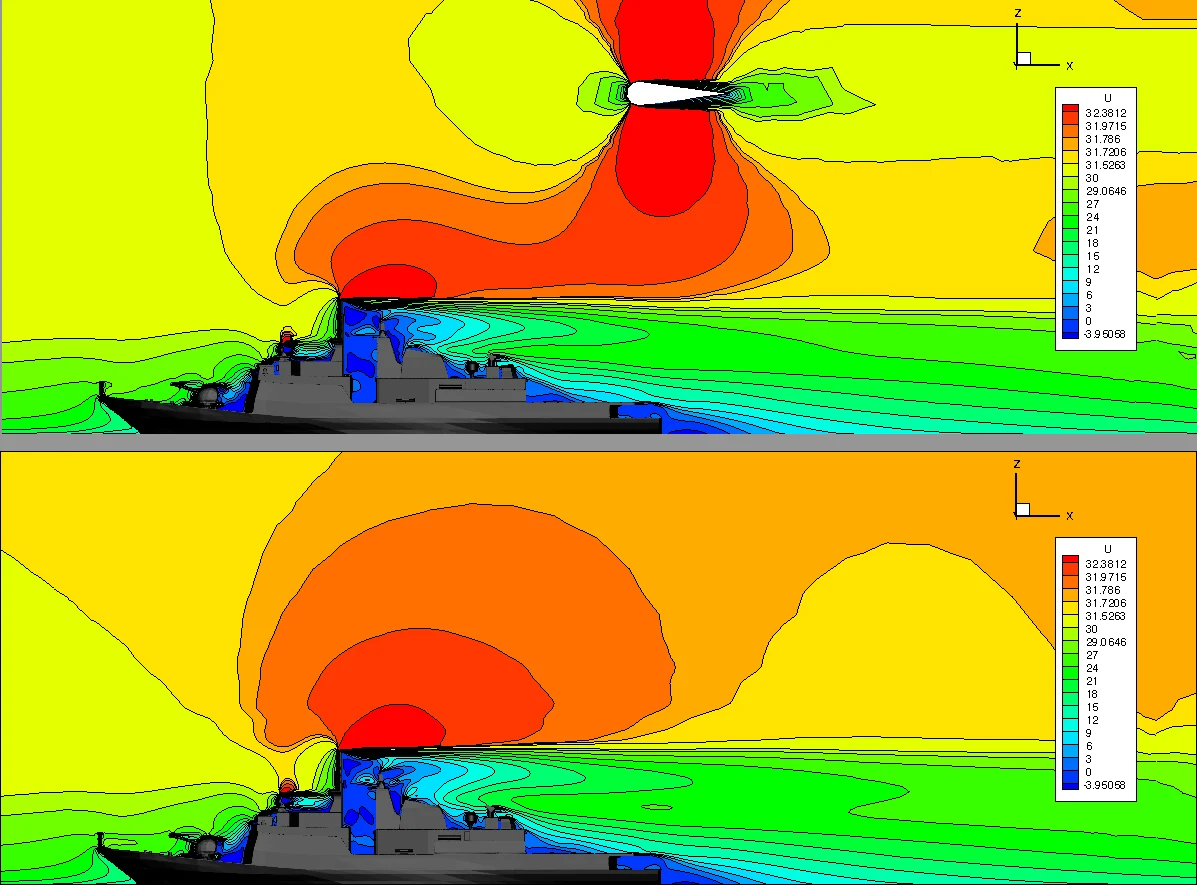
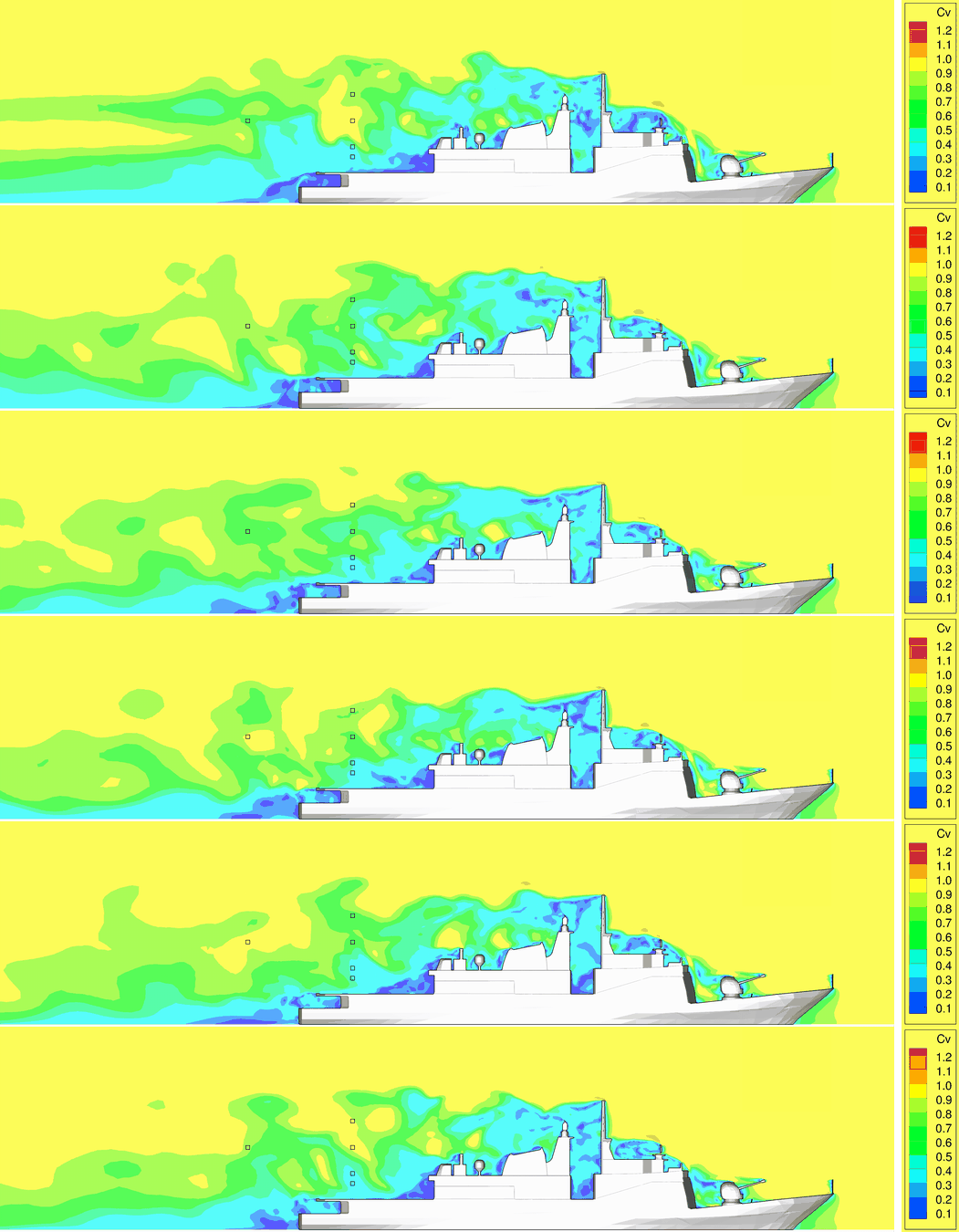
The Navy tested a 1/75 scale model of the corvette Barroso (V-34) in the NLR low speed wind tunnel, at about 30 m/s, with a five-hole probe over the flight deck. Because of time and cost, the tunnel covers few approach paths. ATS simulated the same model with CFD++ (RANS, k-ε model), rotating the ship in 9° steps through 360°, compared it point by point with the tunnel, and built the other paths with CFD. The test and the CFD use a reference speed of about 30 m/s on the 1/75 scale model. The results are used in non-dimensional form, as a fraction of the relative wind measured at the ship’s anemometer (Cv = Vlocal / Vrel), and they hold for the wind speeds of the envelope because the flow separates at the sharp edges of the superstructure and depends little on the Reynolds number.
The result was published at ICAS 2018 (Rafael, da Silva and Guedes): in the final envelope, CFD++ was more conservative than the tunnel, and the local differences in velocity and angle had little effect on the envelope. In 2022, a hybrid RANS-LES simulation of the Lynx landing on the Barroso, also with CFD++ (Batten-Goldberg model), (Pio, Rafael, Villela, da Silva, Ferro and Guedes, ICAS 2022) improved the prediction right behind the structures, where the flow is transient and RANS smooths the vortices.
The Barroso study was also presented at LNCC in June 2018 (LNCC news, 10 July 2018) by Sukumar Chakravarthy, founder of Metacomp Technologies (CFD++), in a talk with CASNAV: the definition of the landing envelope of a helicopter on a Brazilian Navy ship in several wind conditions.

What changes with the Tamandaré
The Tamandaré has a length similar to the Barroso, but its structures are different: more modern and minimalist, designed to reduce the radar signature. The superstructure changes, and so does the flow over the flight deck. The procedure validated on the Barroso was adapted to the new frigate: a model of the ship’s external geometry, checked by the ATS team on board the F200, CFD++ simulations for the full circle of wind directions, and the quantities the Navy uses to build the envelope at the landing spot and along the approach paths.
For the Navy, doing without the tunnel removes the scale model, the logistics of a test abroad and the wait for a tunnel slot and keeps the envelope definition in Brazil, with a procedure it has already checked against tests. The same procedure can be repeated for other Navy ships and other helicopters, without a new wind tunnel campaign for each case.
The RANS results are accurate enough to be used directly in helicopter operations: the CFD-defined envelope of the corvette Barroso is already in use by the Navy, approved by CASNAV. At ICAS 2022, the CFD++ hybrid RANS-LES simulation of the Lynx landing on the Barroso further reduced the errors in the vortex regions over the flight deck, right behind the hangar. It is a possible technology improvement, not a requirement. Sea trials remain the final word: the Navy plans a campaign of landings on board in November 2026 to validate the candidate wind envelope of the SH-16 on the Tamandaré class frigates (Brazilian Naval Air Force Command, June 2026, in Portuguese).
Frequently asked questions
Does CFD replace the wind tunnel test?
In this application, yes, because the procedure was first validated against the NLR tunnel on the Barroso, and in the envelope CFD++ stayed on the conservative side. It does not replace sea trials or helicopter trials, which close the qualification.
Why RANS and not hybrid RANS-LES?
RANS allows sweeping all wind directions within a project schedule. Hybrid RANS-LES is more expensive and is used where the transient flow matters most, in the vortices over the flight deck right behind the structures. The ICAS 2022 work showed that it reduces the errors in those regions. It is a possible technology improvement, but RANS is already accurate enough for operations, as the Barroso envelope in use shows.
Which software was used?
CFD++, from Metacomp Technologies, which ATS distributes in Brazil.
Does the method apply to other ships, buildings, eVTOLs and platforms?
Yes. The problem is the same whenever a structure disturbs the wind over the landing area: rooftop helipads on buildings, vertiports for eVTOLs in urban areas and helidecks on offshore oil platforms, as well as other ships. The procedure validated on the Barroso applies with a model of the external geometry of the structure and its surroundings.
Read more
- Rafael, C. F., da Silva, G. A. L. and Guedes, M. J. M. Ship-helicopter operational limitation envelope definition with CFD results and wind tunnel data. ICAS 2018: PDF and ICAS page.
- Pio, D. M., Rafael, C. F., Villela, P. S. C., da Silva, G. A. L., Ferro, M. and Guedes, M. J. M. Large-eddy simulation of a Lynx helicopter landing in the Barroso corvette ship. ICAS 2022: PDF and ICAS page.
- Direct contract TJIL no. 04/2026, Brazilian Navy Directorate of Naval Aeronautics: Navy portal.
- Services: Aerodynamic analysis, Test supervision and execution and Publications.
Do you have a ship, a platform or a helideck with a wind problem? Talk to an ATS engineer.

