 Skip to content


Cover image: rime ice shapes simulated by iceAccretionFoam on the NACA 0012, compared with NASA measurements.
FAPESP, the São Paulo Research Foundation, has approved the iceAccretionFoam project of ATS4i under its PIPE program, Innovative Research in Small Businesses (grant 2025/19697-9). iceAccretionFoam is a computational fluid dynamics (CFD) software for simulating ice accretion and thermal ice protection on three-dimensional aircraft surfaces. Phase 1 started in May 2026 and runs until December. This post explains the plan for both phases, the technologies behind the code and how it will reach the market.
Summary
- Phase 1 (8 months, May to December 2026): a beta version with 2D rime and glaze ice accretion, validated against literature data. Maturity goes from TRL 3 to TRL 6.
- Phase 2 (2 years): an MVP with 3D ice accretion and thermal ice protection (anti-ice and de-ice). The target is TRL 8.
- Three cutting-edge technologies: immersed boundary, finite area and the rough-wall function of Silva et al., which uses the Stefanini correlation.
- Path to market: first in ATS4i engineering consultancy, as a technical differentiator; then as SaaS, with browser access for large and small companies.
- Team: Guilherme A. Lima da Silva as principal investigator, two FAPESP fellows (TT-5 at doctoral level and TT-4A at master’s level) and training with Prof. Hrvoje Jasak (Wikki).
Back with FAPESP
The project has a special meaning for the person leading it. Guilherme Araujo Lima da Silva, founder of ATS4i and principal investigator of the PIPE project, did his PhD at the University of São Paulo on the numerical simulation of thermal anti-ice systems, completed in 2008. During the first 28 months, the PhD was supported by Embraer, where he worked on the ice protection team: work and study ran in parallel.
The final 20 months were funded by a FAPESP scholarship. It included a period as a visiting scholar at California State University, Long Beach (CSULB). There, Guilherme integrated into his thermal anti-ice code the differential compressible boundary-layer method from the books of Prof. Tuncer Cebeci (1934–2021), co-author of the Cebeci-Smith turbulence model, who headed the aerodynamics research department at Douglas Aircraft and was the first distinguished professor of mechanical engineering at CSULB, where he founded the aerospace engineering department. At CSULB, the work was done in collaboration with Prof. Hamid Hefazi, then chair of the Mechanical and Aerospace Engineering department; Prof. Hsun-Hu Chen, a specialist in CFD, aircraft icing and boundary-layer transition; and Prof. Emeritus Kalle Kaups, who earlier developed 3D wing boundary-layer methods with Cebeci at McDonnell Douglas. That work produced the paper Differential Boundary-Layer Analysis and Runback Water Flow Model Applied to Flow Around Airfoils with Thermal Anti-ice, with Silvares, Zerbini, Hefazi, Chen and Kaups, presented at the 2009 AIAA Aerospace Sciences Meeting. The same line of research had already produced the two Journal of Aircraft papers (AIAA, 2007) on airfoil anti-ice simulation, still his most cited publications.
At the Polytechnic School of the University of São Paulo, the work was carried out with Professors Otávio de Mattos Silvares and Euryale Zerbini, and with Prof. Marcos de Mattos Pimenta, whose work on heat transfer over rough surfaces, done at Stanford, is cited in Kays and Crawford’s Convective Heat and Mass Transfer and in LEWICE reports. Pimenta is also a co-author of the 2011 wall functions now used in iceAccretionFoam.
Almost two decades later, FAPESP is supporting this line of research again, now inside a company and with a product as the goal.

Why simulate ice in 3D
Accreted ice reduces lift, increases drag and weight, and can reach engines, propellers, probes and windshields. On flight AF447, in 2009, the obstruction of the pitot probes by ice crystals was the event that started the accident sequence, according to the final report of the French BEA. Rime ice forms well below 0 °C: droplets freeze almost entirely on impact and the shape changes little. Glaze ice forms just below 0 °C: part of the water runs back, freezes downstream and builds “horns” that always hurt aerodynamic performance. Glaze is much harder to model.

On swept wings, probes, antennas, radomes and inlets, the water runs along the surface shear lines, which do not follow 2D cuts. That is why iceAccretionFoam solves the problem in full 3D, with four advantages: it follows the water along the actual surface shear lines; it models water hydrodynamics as film, rivulets and beads; it grows the ice without re-meshing or deforming the mesh; and it uses rough-surface heat transfer validated against experimental data.

Three cutting-edge technologies
iceAccretionFoam is a single solver built on foam-extend 5.0. It solves together the compressible flow (rhoPimpleFoam), the Eulerian droplet trajectories (driftEulerFoam), the water film and the ice growth. Three technologies make the difference:
- Immersed boundary. The ice grows on a surface immersed in the background mesh, using Prof. Jasak’s Immersed Boundary Surface method (2018). There is no re-meshing or mesh deformation at each step, which makes complex shapes such as glaze horns feasible.
- Finite area. The finite area method (Tuković and Jasak, 2008) solves the water film on the curved 3D surface, with mass, momentum and energy, driven by shear stress, pressure gradient and droplet impingement. In Phase 2, the same method solves 2D heat conduction in a thin shell, the form of electrothermal heaters.
- Silva et al. wall function with the Stefanini correlation. Heat transfer over rough ice uses the thermal and momentum wall functions proposed by Lima da Silva et al. (SAE 2011-38-0023). They account for the thermal resistance of the viscous sublayer and use the Stefanini et al. correlation (AIAA, 2010) for the roughness Stanton number, a correction of the Owen and Thomson correlation. In 2011, the wall functions were implemented in OpenFOAM-1.6-ext, the predecessor of foam-extend, and in CFD++, and validated against Achenbach’s experimental data for a heated rough cylinder, a case with roughness and flow similar to an iced leading edge. Classical icing codes use an integral boundary-layer analysis, with sand-grain roughness taken from pipe flow and an abrupt laminar-turbulent transition. The Stefanini correlation is available as an option in Metacomp’s CFD++.


Partnership with Prof. Hrvoje Jasak, University of Cambridge
Prof. Hrvoje Jasak is Professor of Continuum Physics at the University of Cambridge, where he leads the Computational Continuum Mechanics group at the Cavendish Laboratory, and a director of Wikki. He was the original developer of FOAM (Field Operation and Manipulation) at Imperial College London, during his PhD under Prof. David Gosman. OpenFOAM and foam-extend are both forks of FOAM, and foam-extend is maintained by him. The immersed-boundary and finite-area libraries that iceAccretionFoam extends are his work.
This partnership is what made it possible to use foam-extend as the base of iceAccretionFoam. Instead of writing a code from scratch, ATS4i started from a recognized CFD code that already had the two tools the icing problem needs. Prof. Jasak is a co-author of the iceAccretionFoam papers in Phil. Trans. R. Soc. A and, in the PIPE project, provides advanced training to the team through Wikki.
In September 2023, engineer Jayme Rodrigues Teixeira da Silva, then at ATS4i, attended the NUMAP-FOAM Summer School at the Cavendish Laboratory in Cambridge: two weeks of expert-level lectures and one-to-one project supervision for a small, selected group. There he presented the project and learned in depth the foam-extend framework and the immersed-boundary and finite-area methods. After the school, he worked directly with Prof. Jasak and Guilherme on the code.

Phase 1: a 2D beta in 8 months
Phase 1 has seven deliverables across four fronts:
- Physics: mapping between immersed boundary and finite area, heat and mass transfer on rough surfaces, and roughness-triggered laminar-turbulent transition.
- Validation: 2D rime and glaze ice against experimental literature data, on several airfoils beyond the NACA 0012.
- Product: feasibility studies for SaaS, the graphical interface and AI-assisted (LLM) case setup.
- Qualification: accreditation requirements, a traceability matrix for the standards and the technical feasibility dossier for Phase 2.
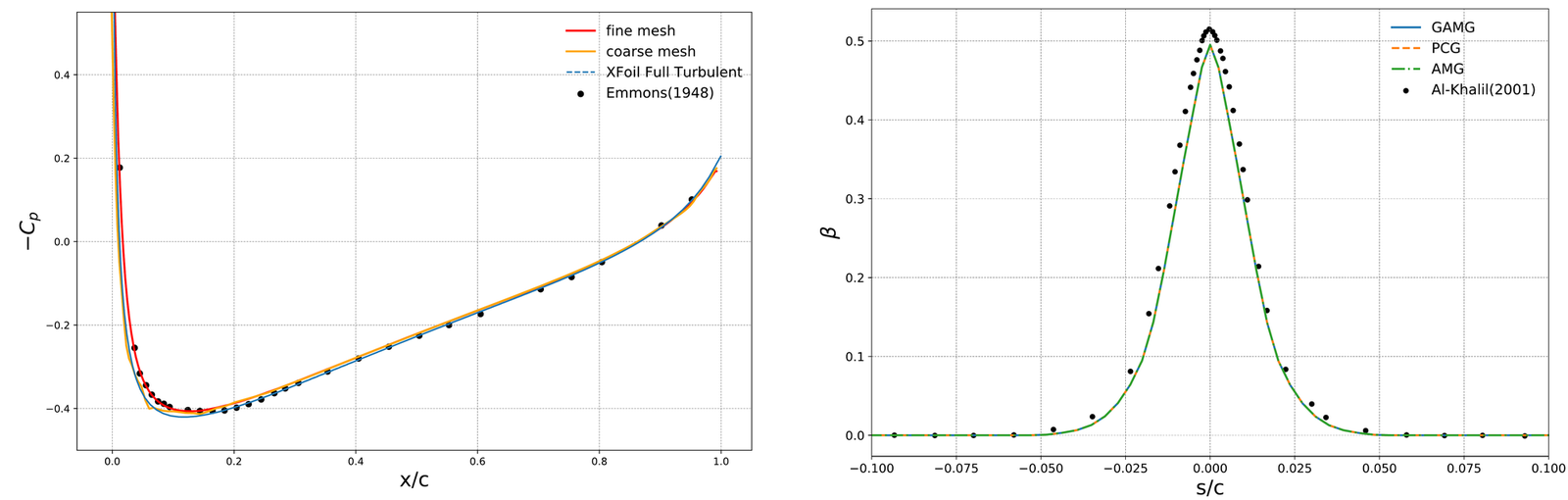
The foundation of the code is already verified: aerodynamics and droplet impingement match the reference data.
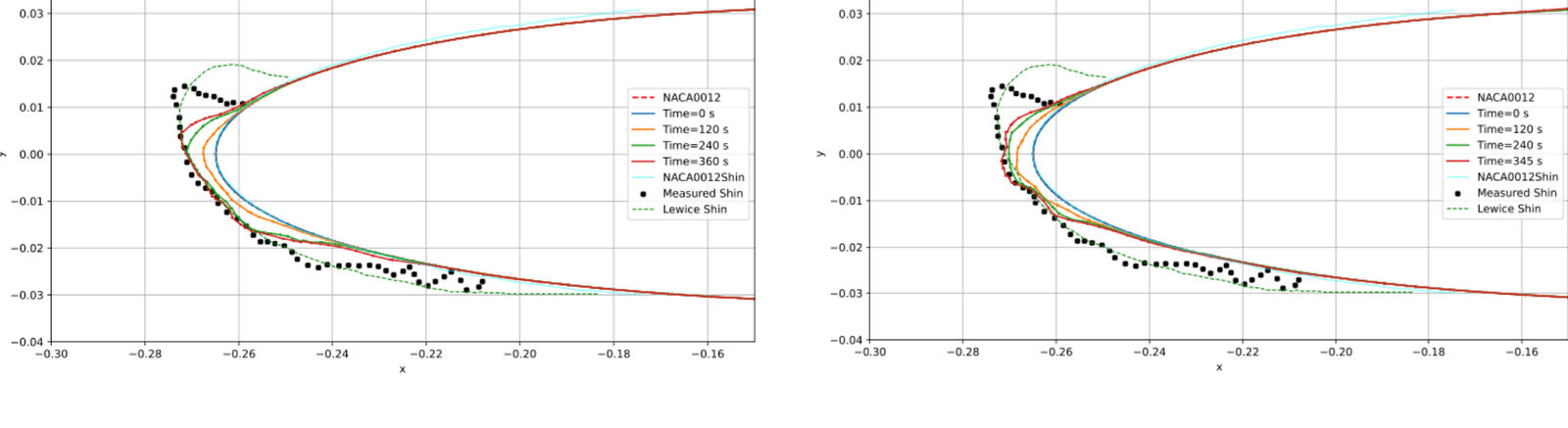
The code starts at TRL 3. For 2D rime, the simulated ice shapes already agree with NASA measurements on the NACA 0012. For glaze, the code reproduces the behavior, but the upper horn is still smaller than measured: the thermal freezing fraction and convective heat transfer with transition are still missing, and they are exactly the Phase 1 work.

The team has Guilherme as principal investigator and two FAPESP fellows: one TT-5, at doctoral level, and one TT-4A, at master’s level. Prof. Jasak, through Wikki, provides advanced foam-extend training. Computers and infrastructure are provided by ATS4i.
Phase 2: a 3D MVP with thermal ice protection
Over two years, Phase 2 takes the code from the 2D beta to a 3D MVP ready for real cases:
- 3D shapes: swept wings, pitot probes and smart probes, air and engine inlets, radomes, antennas, propellers and eVTOL rotors, which have no representative 2D section.
- Supercooled large droplets (SLD): droplet breakup and splashing, required by the Appendix O certification scenarios.
- Thermal protection: the water film exchanges heat with the wall, which is adiabatic in Phase 1. This lets the code simulate anti-ice and de-ice systems, including electrothermal ones.
- One case setup: any ice type, or a protection system, from the same setup, with no operator-specific commands.
Validation follows a ladder: Cp and collection efficiency (β), 2D rime, 2D glaze, 3D shapes and SLD and, finally, ice protection. The last two steps are what Phase 2 exists to produce. The target is TRL 8.


With the MVP in hand, the project also qualifies for other kinds of investment, such as FINEP, industry partners and venture capital.
The market: consultancy with a differentiator
The main market is not the large aircraft manufacturers, which are few and have their own engineering teams. It is the companies that sell equipment needing icing evidence, and the new entrants without an icing team:
- Suppliers: makers of sensors, pitot probes and smart probes, antennas and inlets. There are hundreds in the US alone.
- Modifications and STCs: installing probes, antennas, radomes or new propulsion on already certified aircraft.
- New markets: drones, UAVs, eVTOL and electric aircraft.
- Rule changes: such as the evolution of TSO-C16 for pitot probe heating, which now references SAE AS5562.

ATS4i already provides icing consultancy on probes, wings and eVTOL, with commercial tools and in-house codes. iceAccretionFoam adds a differentiator: a full-3D code developed by ATS4i, with water-film hydrodynamics and validated rough-wall heat transfer, free of the usage restrictions of other codes, such as LEWICE3D, which can only be used by US citizens and within the US. Acceptance comes through validation against tunnel and flight data, presented to the authorities (FAA, EASA, ANAC), to the SAE AC-9C committee, where Guilherme serves as liaison, and to the AIAA Ice Prediction Workshop.

SaaS: icing simulation for large and small companies
The SaaS model will let companies without a CFD team use the technology from a web browser. The client uploads the geometry and the icing condition, an ATS4i engineer reviews the case, iceAccretionFoam runs on ATS4i servers and the results come back through the web, with a report. There is nothing to install and no hardware on the client side, and updates are centralized. A service subscription is more flexible than the per-machine, per-user software licenses common in the market.

iceAccretionFoam derives from foam-extend and is therefore licensed under the GNU GPL v3. The GPL only imposes obligations when a copy of the program is conveyed to others. Running the modified code on ATS4i servers, or on cloud infrastructure contracted for that purpose, is not distribution: in consultancy and in the SaaS, the client receives results and reports, not the program. That is why ATS4i consultancy with iceAccretionFoam can be carried out under a non-disclosure agreement (NDA), which protects the client’s geometry, data and results. If a copy of the code, customized or not, is delivered to a client, it is licensed under the GPL v3: it comes with the source code, and the client may use, modify and redistribute the program; an NDA cannot restrict that. In Phase 1, SaaS is a feasibility study, including information security and data privacy; implementation comes in Phase 2.
Read more
- iceAccretionFoam at SAE AC-9C, at CIRA (Capua, Italy): the development plan presented to the committee.
- SAE AC-9C presentation (PDF): rime and glaze results and roadmap.
- Teixeira da Silva et al. (2024). Initial development of a CFD icing tool. ICAS 2024, Florence, Italy. ICAS 2024-1112 (PDF)
- Teixeira da Silva et al. (2025). Introducing the iceAccretionFoam solver: impingement and rime ice. Phil. Trans. R. Soc. A. DOI 10.1098/rsta.2024.0362 · PDF
- Carvalho et al. (2025). Advancing the iceAccretionFoam solver: glaze ice accretion. Phil. Trans. R. Soc. A. DOI 10.1098/rsta.2024.0361 · PDF
- Lima da Silva et al. (2009). Differential Boundary-Layer Analysis and Runback Water Flow Model Applied to Flow Around Airfoils with Thermal Anti-ice. AIAA Aerospace Sciences Meeting (CSULB work). PDF
- Lima da Silva et al. (2011). Proposed Wall Function Models for Heat Transfer around a Cylinder with Rough Surface in Cross Flow. SAE 2011-38-0023. DOI 10.4271/2011-38-0023 · PDF
- ATS at the NUMAP-FOAM Summer School 2023, Cambridge
- ATS4i publications
- Service: ice formation analysis and simulation for ice protection systems
- Leia em português
- Numerical Simulation of Convective Heat Transfer for In-Flight Icing (2023)
- “The Icing Engineering Process”: SUNY Korea lecture (2022)
- Handbook of Numerical Simulation of In-Flight Icing (2022)
Frequently asked questions
What is FAPESP PIPE?
It is the FAPESP program that supports research for innovation in small companies in the state of São Paulo, in phases: Phase 1 demonstrates technical feasibility and Phase 2 develops the product.
When will iceAccretionFoam be available?
The 2D beta will be ready at the end of Phase 1, in December 2026, for internal use. The 3D MVP is the Phase 2 deliverable. ATS4i icing consultancy is available today.
Will the code be sold as a software license?
Not as a proprietary license. iceAccretionFoam derives from foam-extend (GNU GPL v3) and will be used in ATS4i consultancy and offered as a service (SaaS), running on ATS4i servers, which the GPL v3 allows. If a client receives a copy, customized or not, it is licensed under the GPL v3, with the source code. The GPL allows charging for copies, customization and support, but not restricting redistribution.
Who can benefit?
Aircraft manufacturers, makers of sensors, probes and antennas, STC companies, and drone and eVTOL programs that must demonstrate safety in icing conditions.
Need to assess icing effects or size the thermal protection of your product? Talk to ATS4i.
Project supported by the São Paulo Research Foundation (FAPESP), grant 2025/19697-9. The opinions, hypotheses and conclusions or recommendations expressed in this material are the responsibility of the authors and do not necessarily reflect FAPESP’s views.


